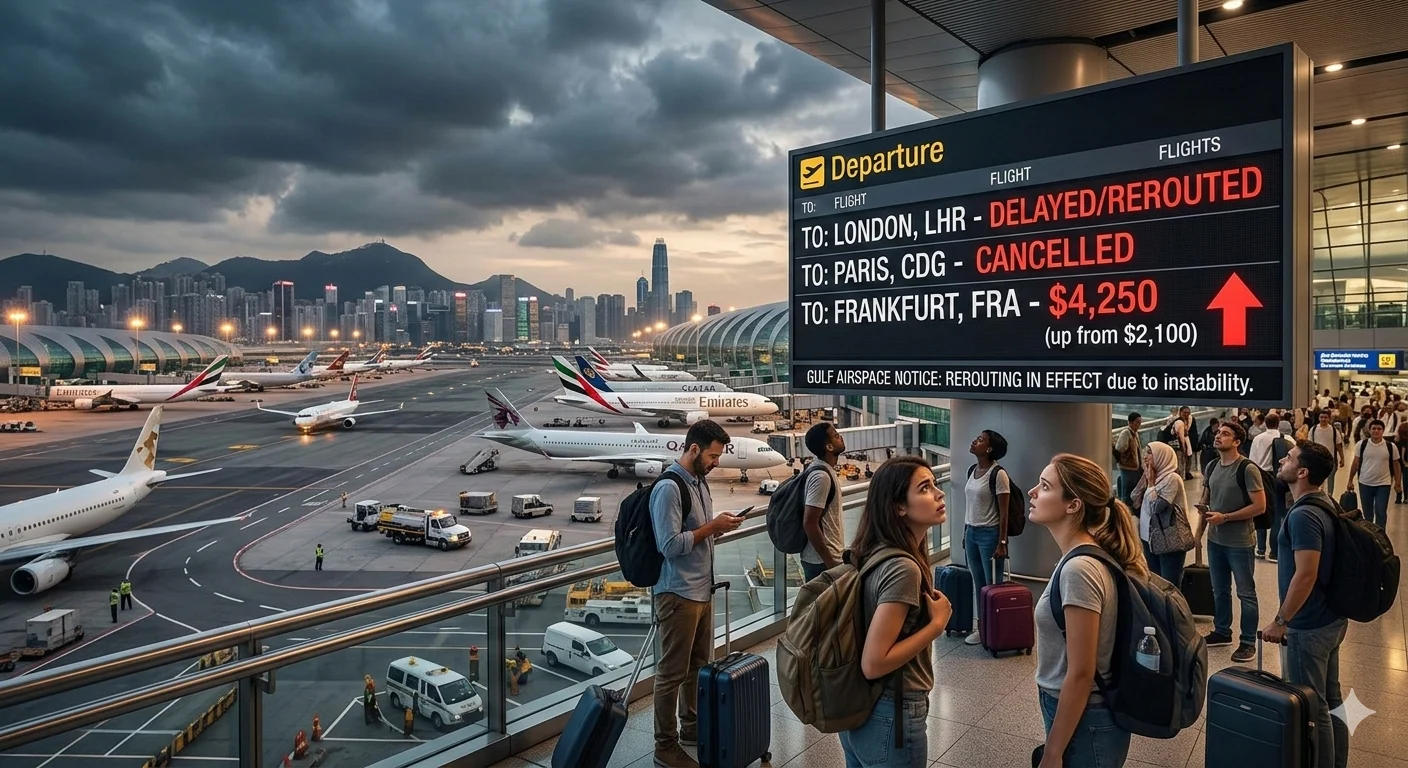
If you’ve tried to book a flight between Asia, Australia, and Europe in the last few weeks, you’ve likely stared at your screen in disbelief. The “Big Three” hubs –Dubai (DXB), Doha (DOH), and Abu Dhabi (AUH) which usually function like a perfectly oiled global conveyor belt, are currently facing unprecedented restrictions.
As someone who flew these airlines for their seamless connectivity and convenience, seeing the “Gulf Corridor” restricted feels like watching the world’s main artery being pinched. Here’s the breakdown of what’s happening, why the map has changed, and why your wallet is feeling the burn.
1. The “Big Three” Hubs: From 100% to Survival Mode
Since late February 2026, the escalation of regional tensions has forced a dramatic shift in how Emirates, Qatar Airways, and Etihad operate. While they haven’t shut down entirely, they are operating under “Restricted Flow.”
- Transit Is the Target: These hubs thrive on transit normally, about 70% of passengers at Zayed International (AUH) are just passing through. Current restrictions mean airlines are often only accepting passengers with confirmed, immediate connections or those whose final destination is the hub itself.
- Capacity Slashing: We are seeing nearly 21,300 flight cancellations in just a matter of weeks. Industry data suggests the hubs are operating at roughly 40% of their normal capacity through mid-March 2026.
- The Safety First Rule: As Sharon Petersen recently noted at Airline Ratings, these carriers are world-class for a reason: they won’t fly if the risk is even 1%. They are currently prioritizing “Safety Corridors,” which are narrow, vetted paths that avoid active missile threats but severely limit the number of planes that can take off and land per hour.
2. The Global Ripple Effect: Australia and India Hit Hardest
The Gulf isn’t just a destination; it’s the bridge for the “Kangaroo Route” and the “Indo-European” corridor.
- Australia–Europe: With the Gulf hubs restricted, the burden has shifted to Singapore (SIA) and Hong Kong (Cathay). However, these hubs weren’t built to absorb the entire world’s transit overnight.
- India’s Struggle: Indian carriers are facing a double whammy. Because they still cannot use Pakistani airspace for many routes, they are being forced into massive detours south toward Oman or north toward the Caucasus.
3. Why Are Fares Soaring? (It’s Not Just Greed)
It’s easy to blame “price gouging,” but the economics of 2026 aviation are currently brutal.
- The Fuel Spike: Jet fuel has hit nearly $200 per barrel due to the disruption of shipping through the Strait of Hormuz. Even with fuel hedging, airlines are feeling the squeeze and passing that 30% jump in costs directly to the consumer.
- The “Long Way Round”: Avoiding restricted airspace adds 90 minutes to two hours of flight time. That’s extra fuel, extra crew overtime, and extra maintenance.
- Supply vs. Demand: When 15,000+ flights vanish from the schedule but the people still need to get home, the remaining seats become digital gold. We are seeing economy fares that used to be $1,200 (USD) spiking to $4,000 for a one-way ticket.
What Should You Do?
My advice for travel through mid-2026:
- Look East: If you can, route through Singapore, Tokyo, or Seoul. It might be a longer total journey, but the reliability is currently higher.
- The “Istanbul Alternative”: Turkish Airlines is becoming the big winner here. Istanbul (IST) sits just far enough north to avoid the current restriction zones while still offering that “one-stop to everywhere” convenience.
- Hold Your Miles: Don’t burn your points on these emergency inflated prices if you can avoid it. Wait for the corridor to stabilize.
The Gulf hubs have survived crises before, and they will again. But for now, the “crossroads of the world” is a very narrow path.
Cahill Merch Now Available!
I’ve just launched my exclusive line of Cahill Merch, get your hoodies, beanies, mugs and more today!